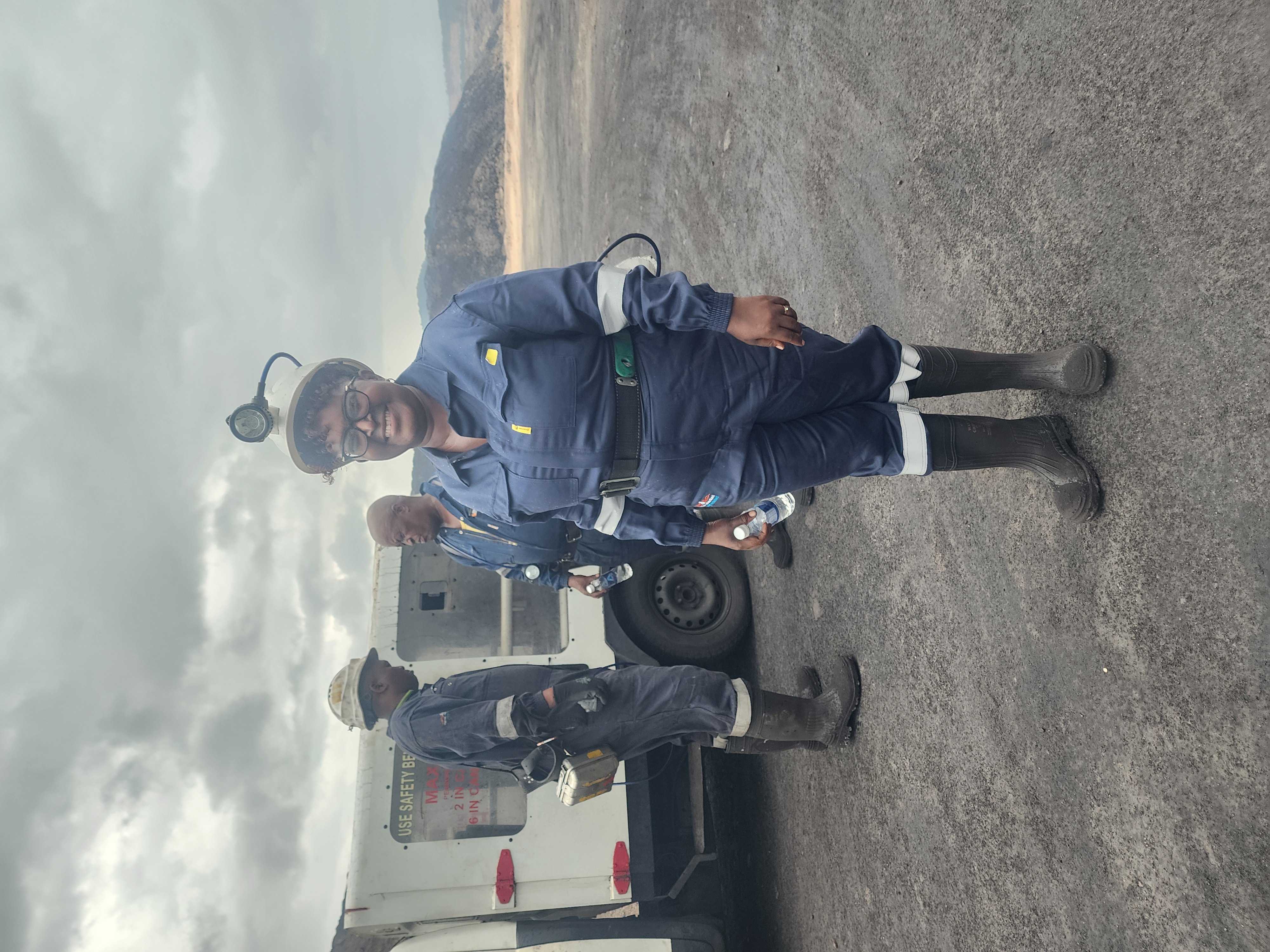
Rachiel Bvurire is a metallurgical engineer with Zimbabwe’s Ministry of Mines and Mining Development. Although she was already highly qualified and technically experienced, limited confidence and a fear of public speaking had prevented her from fully stepping into leadership and advocacy roles in a sector that remains largely dominated by men.
Summary
After completing the Australia Awards Africa Short Course on Mining Governance in Africa, Rachiel began using her expertise in new ways. She has since become a keynote speaker, a cohost of community radio programs, leader of the Matabeleland audit team, coauthor of a published journal article, and a part-time lecturer and mentor. Through workshops and seminars, she has advised close to 200 women, while her radio programs have reached an estimated audience of more than 10,000 listeners.
Her journey demonstrates how communication and leadership skills can help an established technical professional extend her influence beyond the workplace and contribute more widely to safer, more responsible, and more inclusive mining practices.
A technically accomplished professional finding her voice
Rachiel holds a Bachelor of Science in Metallurgical Engineering and a Master of Science in Advanced Mineral Processing and Extractive Metallurgy from the University of Zimbabwe. She works as a metallurgical engineer for Zimbabwe’s Ministry of Mines and Mining Development, where her responsibilities include transferring technical knowledge, conducting mine inspections, enforcing compliance, disseminating mining legislation, and issuing permits.
Despite her qualifications, low self-esteem and a fear of public speaking made it difficult for her to engage wider audiences and confidently assert herself among peers. She had the technical knowledge, but not yet the confidence to communicate it across the different settings where it could have greater influence.
This challenge is particularly significant in a mining sector where women remain underrepresented, especially in technical and leadership positions. Women in mining may continue to face prejudice, exclusion, and persistent undermining even when they possess the required qualifications and expertise.

Why inclusive mining governance matters
Mining contributes approximately 75 per cent of Zimbabwe’s export earnings and around 16 percent of the country’s Gross Domestic Product. Zimbabwe is rich in mineral resources, including platinum group metals, gold, chrome, and Africa’s largest lithium reserves.
However, governance challenges continue to affect the sector, particularly within small scale mining. Small scale and artisanal miners form a significant part of Zimbabwe’s mining community, but many operate informally. Unsafe practices, the use of illegal chemicals, and limited attention to health and safety standards can contribute to accidents and environmental harm.
Across many parts of Africa, natural resources can also become sources of conflict when governance systems fail or when communities clash with political actors and security forces. In such circumstances, minerals may become associated with instability and conflict, reducing their appeal to international markets.
This context underlines the importance of including small scale and artisanal miners in knowledge sharing and governance processes.
Finding confidence through Australia Awards
In 2025, Rachiel was selected alongside professionals from across Africa to participate in the Australia Awards Africa Short Course on Mining Governance in Africa, delivered by The University of Queensland in Australia. Parts of the program were also delivered at Curtin University in Perth by academics including Professor Eric Lilford and Dr Muza Gondwe.
The course exposed participants, many of whom were engineers, to the broader governance and business dimensions of mining. This included investment principles, internal rates of return, and approaches to safer, more sustainable, and conflict sensitive mining informed by Australia’s strong mining governance systems.
Importantly for Rachiel, the course also included communication and leadership training designed to strengthen participants’ engagement with mining communities, policymakers, traditional leaders, and custodial authorities.
Australia Awards Africa places strong emphasis on gender equality, disability equity and rights, and social inclusion. Through capacity building, leadership training and networking forums, the Program seeks to empower women and equip them to take charge.
Rachiel credits the University of Queensland academic team, particularly Dr Lynda Lawson, Senior Research Fellow at the Global Centre for Mineral Security, with helping to transform her confidence and leadership capacity during the Short Course.
Armed with stronger communication skills and greater confidence, she has since been able to share her knowledge at both high-level conferences and grassroots community engagements across Zimbabwe.

Taking knowledge beyond the workplace
As part of her Reintegration Action Plan, Rachiel set out to increase the number of small-scale miners reached through knowledge sharing platforms such as workshops, seminars, and radio programs.
Since completing the Short Course in March 2025, she has established a stronger presence in civil society and nonprofit spaces. She has presented at workshops hosted by the Zimbabwe Association of Women in Mining and the Women’s Institute for Leadership Development, where she advised close to 200 women on mining license acquisition processes and advocated for standard mining safety regulations and protocols.
Through these engagements, she has shared her technical knowledge beyond her formal government role, advising women on mining license acquisition and advocating for standard mining safety regulations and protocols.
Leadership within the Ministry
Rachiel is now leading the Matabeleland audit team across five mining provinces in Zimbabwe. She says this responsibility has never been assigned to a woman within the Ministry of Mines and Mining Development.
Each audit unit comprises eight personnel. To date, her team has audited six large scale mining operations: Turk Mine, Old Nic Mine, Zambezi Gas and Coal, Makomo Resources Limited, Waterwitch Gold Mine, and Kamativi Mining Company. The team has also audited more than 10 small scale mines and elution plants.
Her former supervisor at the University of Zimbabwe, Sharrydon Bright Chinosengwa, who is now based in the United States at Element USA, has observed her professional development:
“I have been impressed by how quickly she has applied her new qualification. She took the initiative to improve the mine audit system, which resulted in better mineral accountability. I have also seen an improvement in her confidence when it comes to speaking engagements.”
Turning research into policy engagement
Rachiel has also strengthened her contribution to research and policy discussions within the mining sector.
She coauthored a journal article through the Zimbabwe School of Mines titled “Gold Recovery from Cyanide Based Leach Solutions Using Zinc Cementation: A Case of Small-Scale Gold Mining in Zimbabwe.” The paper was published in the International Journal of Mineral Processing and Extractive Metallurgy, Volume 10, Issue 4, in 2025. It was coauthored by Rachiel Bvurire, Yemurai Vengesa, Kupakwashe Lindsay Mahamba, Sharrydon Bright Chinosengwa, and Hlanganipai Ngarivume.
Before publication, the paper was presented at the International Symposium on Earth Science and Technology 2024 at Kyushu University in Japan. The event was hosted by the Cooperative International Network for Earth Science and Technology and brought together representatives from the global mining industry, government, policy, investment, innovation, environmental advocacy, and technical fields.
Rachiel has since moved the research into the policy arena. She submitted the findings to the Permanent Secretary of the Ministry of Mines and Mining Development, who expressed appreciation and assured the team that the findings would be tabled before the incoming minister.
Rachiel hopes the recently appointed minister will take the findings into account when setting a new agenda for the Ministry, particularly in relation to stronger regulation of chemicals and extraction methods in small scale mining.
Reaching miners through radio
Today, Rachiel cohosts community radio programs aimed at educating and empowering small scale and artisanal miners in southern Zimbabwe. The activities have been running since June 2025 and receive ministerial support as part of the government’s broader efforts to keep miners informed about new and emerging trends in the industry.
In rural communities where internet access remains limited, radio continues to be one of the most effective ways of reaching local audiences. Through programs broadcast in Ndebele on Khulumani FM, Rachiel explains government mining policies, environmental standards, and health and safety regulations in accessible language.
Through these radio sensitisation programs, she has reached an estimated audience of more than 10,000 listeners.
Reflecting on her experience, Rachiel said:
“I am so grateful to have been selected for an Australia Awards Africa Short Course. The opportunity gave me the capacity to do more within the mining sector. Without the opportunity, I may never have discovered my potential. Beyond working for the government, I am now able to reach wider audiences through radio and mining events and contribute meaningfully to the improvement of the mining sector in my country.”
Teaching and mentoring the next generation
Alongside her government work and public engagement, Rachiel teaches part time at the Zimbabwe School of Mines. She lectures on Pyrometallurgy, Mineral Processing, and Principles of Extractive Metallurgy.
Her influence extends beyond formal teaching. Sandile Makhiwa, a final year Geology student, described Rachiel’s role as both an educator and mentor:
“Rachiel Bvurire believed in me when I doubted myself, and through her kindness and support, she helped me succeed and continues to be a mentor.”
Lessons learned
Communication strengthens technical leadership
Rachiel’s experience shows that technical expertise alone is not always enough to create wider influence. The ability to communicate clearly with diverse audiences can open opportunities for leadership, advocacy, and public engagement. Stronger communication skills helped her move from working largely behind the scenes to becoming a keynote speaker, radio host, and respected mining commentator.
Learning continues throughout a professional career
Australia Awards Short Courses are designed for professionals who are already established in their fields. Rachiel’s experience reinforces the value of continuous learning. For her, the most important transformation did not come from technical mining knowledge alone, but from gaining greater confidence in public speaking, communication, and engagement.
Small scale miners must be included
Small scale and artisanal miners are a critical part of Zimbabwe’s mining ecosystem. Excluding them from knowledge sharing and governance processes can increase risks related to safety, environmental management, and accountability. Sustainable mining policies and practices must therefore include both large-scale operators and smaller community-based miners.
From a qualified metallurgical engineer who once hesitated to speak publicly, Rachiel has become a visible leader, educator, researcher, and advocate. By combining her technical expertise with stronger communication skills, Rachiel is now reaching wider audiences through radio and mining events and contributing to the improvement of the mining sector in Zimbabwe.
Connect with us
Any questions?
If you cannot find the answer on our FAQs page, feel free to get in touch by emailing .