
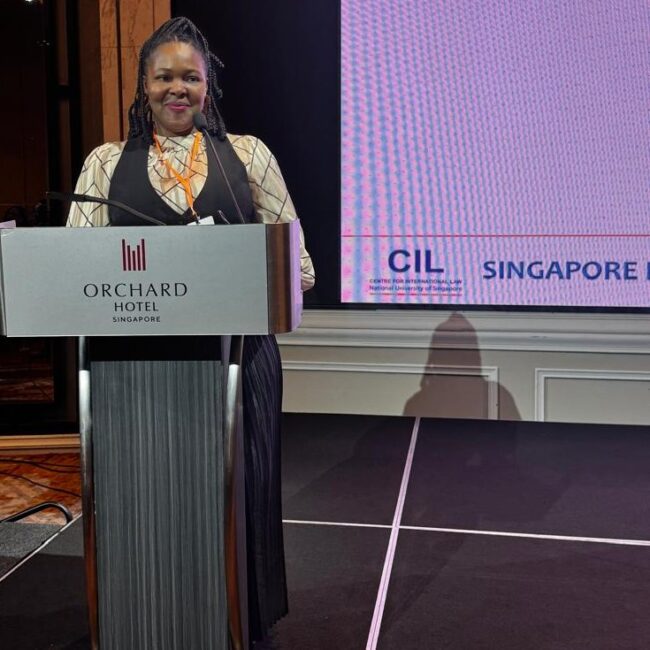
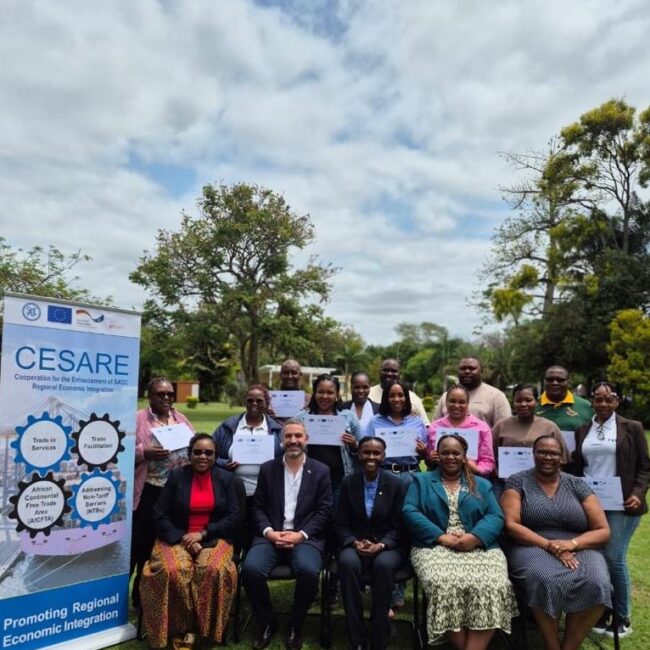
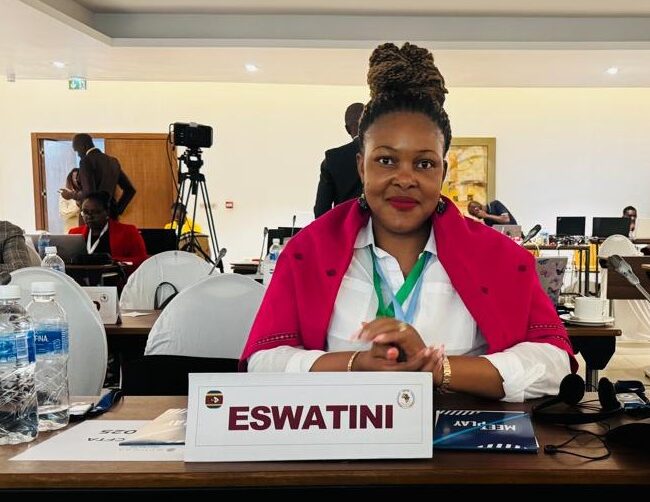
Lungile Mamba works as a Legal Trade Officer at Eswatini’s Ministry of Commerce, Industry and Trade. She is an alumna of the Australia Awards Short Course (AASC) Enhancing Continental Trade Facilitation in Africa, which was delivered by Adelaide University in March 2025. Lungile is a member of the Eswatini National Trade Facilitation Committee (ENTFC) Secretariat and leader of the Legal Analysis Technical Working Group of the ENTFC.
At the Ministry of Commerce, she is responsible for the preparation and coordination of all World Trade Organisation (WTO) notifications on behalf of Eswatini, including the preparation of customs valuation notifications, drafting, negotiating, reviewing, and advising on agreements between local commercial organisations and government, international and regional organisations. She provides technical expertise on trade negotiations and international trade agreements to which Eswatini is a party, while also playing an advisory role on the application of WTO Dispute Settlement Procedures, ensuring Eswatini’s compliance with regional and international trade agreements.
Although Eswatini ratified the WTO Trade Facilitation Agreement, the treaty’s implementation has been delayed by redundant border control measures, high trade costs, numerous bureaucratic and institutional requirements, and inter-agency communication bottlenecks, which collectively slow down trade efficiencies and the competitiveness of Eswatini’s goods in the region and beyond.
As part of her participation in the course, Lungile developed a Reintegration Action Plan (RAP) that focused on Coordinated Border Management (CBM) to contribute to Eswatini’s ability to attract and sustain regional trade. The main objective of Lungile’s RAP was to ensure that she would spearhead the production of the first draft of Eswatini’s new Trade Facilitation Legislation in her role as a Legal Trade Officer at the Ministry of Commerce. The draft legislation spells out Eswatini’s new Border Management and Trade Facilitation Bill and the Inter-Agency Standard Operating Procedures Framework on CBM. In addition to her work with the Ministry of Commerce, Lungile coordinates meetings between the participating agencies and serves as project manager for the working group overseeing the initiative. She is also part of the legal team responsible for drafting the framework, while technical officers focus on the specialised policy and operational content.
The new legislation will make Eswatini’s border posts one-stop centres, enabling ease of trade, importation and exportation processes, and the movement of people and services with neighbouring countries, while advancing the country’s Electronic Single Window System, which is a digital platform that allows traders to submit documentation through a single entry point rather than multiple government agencies. The Inter-Agency Framework also sets operational time limits for border controls and introduces Simplified Trading Arrangements to lower costs for small-scale cross-border traders.
The final modalities of the comprehensive trade facilitation legislation in Eswatini are at an advanced preparatory stage as a result of advocacy and collaboration efforts across various government and parastatal institutions. The trade bill will ensure there is sustained cooperation and collaboration with the private sector, regional and international trade bodies, key among them the WTO and the Southern African Customs Union (SACU).
A draft of the framework has been developed and circulated to relevant stakeholders for consultation and review. Their feedback will inform further revisions before the draft progresses through the next stages of development and approval. The contributions of bureaucrats such as Lungile Mamba, who benefited from the short course, have expedited the development of the trade legislation, all thanks to the international exposure Lungile has had. This has meant that a legal draft of the trade bill was produced in one year because of the technical expertise of Lungile Mamba and her Legal Analysis Technical team at the Ministry of Commerce, in association with other relevant stakeholders.
Upon completion of this first-of-its-kind trade legislative framework and its implementation through the House of Assembly, the legislation is expected to reduce cross-border trading time and costs for thousands of small and medium-scale enterprises, traders and international businesses operating through Eswatini’s ports of entry and exit. It is also projected to boost export earnings and contribute significantly to national economic growth. The reforms are aligned with the African Continental Free Trade Area (AfCFTA), which seeks to create a single African market for goods and services.
In addition to her national work, Lungile remains connected to fellow Australia Awards alumni across Africa through email, WhatsApp, and virtual consultations. These informal exchanges allow her to share experiences, seek advice, and learn from similar trade reform efforts in other countries.
“This project proves that the Australia Awards provides the critical technical capacity needed for alumni to lead high-level policy reforms. This legislation is not just a document; it is the engine that will drive Eswatini’s integration into the global trading system. Legislative processes take time, but we are happy we have made progress in less than a year,” said Lungile Mamba.
Although legislative scope and breadth differ between countries, Lungile attributes the academic guidance she received from the University of Adelaide, Professor Peter Draper, Dr Nathan Gray, and Ms Catherine Grant-Makokera for providing her with the trade legislative knowledge that has informed her contribution to this work.
Trade remains one of the key drivers of Australia-Africa relations, particularly in the extractive industries, including oil, gas, and mining. More than 170 Australian Stock Exchange-listed companies operate across 35 African countries, with a significant concentration in Southern Africa. In June 2025, Australia signed a Memorandum of Understanding with the African Continental Free Trade Area Secretariat to strengthen trade and economic cooperation. The success of this partnership depends on the capacity of individual countries to remove barriers and modernise border operations.
In Eswatini, this work is being advanced through Lungile Mamba’s Reintegration Action Plan. Before undertaking the AASC, Lungile had identified the need to address Eswatini’s lack of a robust legal framework to expedite and expand the scope of trade across the Southern African region and the continent at large.
Through her role as a Trade Facilitation Officer, she continues to draft, negotiate and review agreements, advise on international trade obligations, and ensure Eswatini’s compliance with regional and global trade frameworks. This reflects the development contribution she is making in her home country through her RAP, supported by the knowledge and insights gained during her AASC. Lungile has gained the confidence to spearhead the policy drafting process using a comparative framework analysis model. She was also able to pivot her competencies along with the expertise gained from the AASC; in so doing, she is also cascading her knowledge to her peers in the Ministry of Commerce.
Connect with us
Any questions?
If you cannot find the answer on our FAQs page, feel free to get in touch by emailing .