
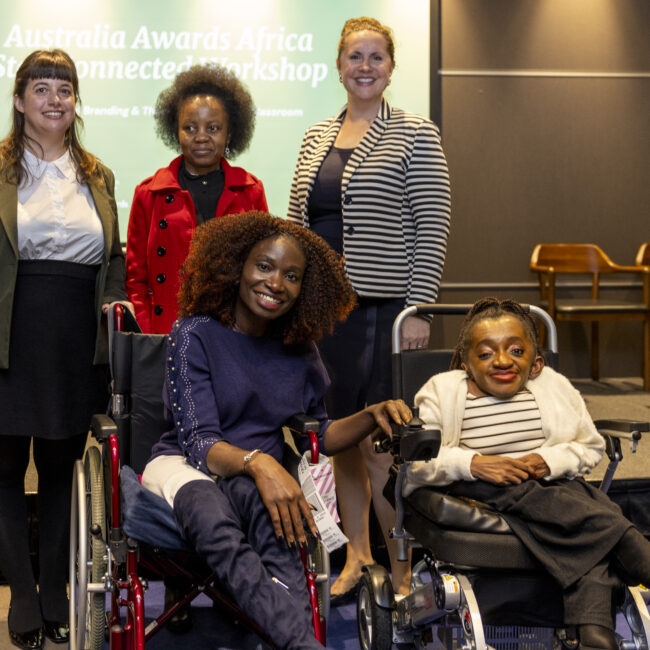
A cohort of 38 Australia Awards Africa scholars converged in Adelaide, South Australia between 12 and 13 June 2025 for the Stay Connected and Reintegration and Career Planning workshops. The workshops brought together a cohort of on-award postgraduate scholars who mobilised to Australia between 2024 and 2025.
The workshops are an integral part of helping scholars make the most of their time in Australia while harnessing their potential to contribute to the development of their home countries upon completion of their studies. The workshops included sessions such as Reintegration and Adjusting to New Cultures led by Denis Jato an Australia Awards Short Course alum who is currently pursuing a PhD at the Queensland University of Technology. Denis Jato’s research pursuits explore migration, integration and cultural adaptation. His experiences of living and studying in Australia coupled with his expertise resonated with the scholars, many of whom are still adjusting to life away from home. The workshop also drew facilitators from Professional Resumes Australia- an organisation of expert resume writers and career coaches. Michaela McElligott- Professional Resumes Australia Founder and Training Team Lead and Emma Hale- Resume Writer, Coach and Trainer led the Career Planning and Resume Reviewing session. The pair shared insights on the importance of personal branding, online visibility and networking to enhance career opportunities. Meanwhile, Cara Ellickson- Director of the Gender Consortium at Flinders University facilitated the Gender Equality, Diversity and Social Inclusion (GEDSI) session.

The Australian government is championing gender equality through various government frameworks including the Department of Foreign Affairs and Trade’s (DFAT) International Gender Equality Strategy launched in February 2025. Australia Awards Africa funded by DFAT supports equality at two co-dependent and symbiotic levels; (i) targeted approaches to enhance success and accessibility for women in their diversity through empowerment initiatives and (ii) integrated approaches that mainstream gender equality across projects, activities and plans. Gender equality is also prioritised at Australia Awards Africa by creating opportunities for women scholars to succeed in male-dominated sectors such as cyber security. For Veda Dawoonauth from Mauritius, pursuing a Master of Cyber Security signifies breaking barriers in a male driven sector. With a postgraduate qualification from The University of Queensland, she hopes to contribute to Mauritius’s cyber architecture and policy endeavours.
The 21st century is defined as the digital age, with emerging technologies and gender equality at the heart of innovation and social development. According to the World Economic Forum’s Global Gender Gap Index of 2024, as technology becomes increasingly central to business transformation, the concentration of women in Artificial Intelligence engineering has more than doubled since 2016. Although women are underrepresented in Science, Technology, Engineering and Mathematics (STEM) related fields, comprising only 28.2% of the STEM workforce compared to 47.3% in non-STEM sectors, female enrolment in STEM and Information Communication Technology (ICT) related university courses has increased significantly since 2006, a development that will have cumulative spill-over effects in STEM employment statistics globally.
“I would like to be a leading figure in the field of cyber security and influence the development of cyber security policies- to make a cyber-resilient Mauritius. I chose to come to Australia as Australia is the first G20 country to have a dedicated cyber security minister and is ranked number 1 among countries in the world showing progress and commitment to enhance cyber security”.
Veda Dawoonauth – Mauritius.
Australia ranked number 24 out of 146 countries on the World Economic Forum’s Global Gender Gap Index of 2024. With the exception of Namibia which ranks 8th on the same index, many African countries where scholars are drawn from, lag behind. For Australia Awards Africa, gender equality, disability, and social inclusion (GEDSI) are considered cross-cutting priorities. Australia Awards scholarship recipients not only demonstrate the potential to contribute to program outcomes but also show a strong commitment to long-term GEDSI focused development, as reflected in their Reintegration Action Plans. When asked how participating in the Stay Connected and Reintegration and Career Planning workshops had been beneficial, Florence Mudzingwa currently pursuing a Master of Disability Practice and Leadership at Flinders University, shared the following:
“The workshops have helped me align my Reintegration Action Plan with my studies. I can now contextualise my ideas by recognising, understanding, and identifying areas to strengthen or improve. With the invaluable knowledge and skills, I am developing, I feel confident in implementing my Reintegration Action Plan. Participating in the workshops has helped me enhance my knowledge and apply practical skills. For example, the session on professional branding and thinking outside the classroom provided me with valuable insights to improve my social media presence to stand out in the professional world. It was also a wonderful opportunity to connect with fellow scholars from different universities, sharing updates, encouraging one another on our academic journeys and exploring ways to collaborate on initiatives using our diverse skills”.
Florence Mudzingwa – Zimbabwe
Florence is a disability rights activist from Zimbabwe and the founder of Hope Resurrect Trust, a social enterprise advocating for the welfare, empowerment and inclusion of persons with disability. At the height of the Covid 19 pandemic, Florence rallied women with disabilities in her community to turn to online and social media marketplace vending in response to lost incomes due to state-wide lockdowns and travel restrictions. With a postgraduate from Australia, Florence hopes to achieve even more towards gender equality and disability inclusion upon returning home.
Australia is one of the world’s leading destinations for international students pursuing higher education. According to a 2022 report by the United Nations Educational, Scientific and Cultural Organization (UNESCO), the country ranks among the top 10 globally in attracting talented individuals seeking to further their education abroad. Beyond its strong reputation in education, Australia is also a major player in the global mining industry. In 2024, the sector generated revenue of US$792 billion globally. As highlighted in PricewaterhouseCoopers’ annual mining report, Australia is at the forefront of advancing sustainability and driving the shift toward a low-carbon future in mining. The country continues to produce some of the world’s most capable current and future policymakers, experts, and mining engineers. Take for instance Salmin Ibrahim Mshindo who is studying a Master of Science (Minerals and Energy Economics) at Curtin University and is inspired to bring gender sensitive mining value-chain analytic optimisation to his home country Tanzania.
“My long-term professional ambition is to establish a mining consultancy firm in Tanzania, specialising in both technical and financial analytics for projects ranging from artisanal to large-scale operations. Inspired by my late mother’s experience as an artisanal small-scale miner facing significant challenges in a male-dominated industry I am committed to advancing women’s participation in mining as the firm’s foremost priority. To fulfill this vision, I will partner with my wife, a professional mining engineer, combining our expertise to support and empower women across the sector”.
Salmin Ibrahim Mshindo – Tanzania
The Stay Connected and Reintegration and Career Planning workshops not only seek to foster collaboration, networking and reintegration preparedness but also allow scholars an opportunity to establish connections outside of the university setting. In a survey carried out after the workshops, 100% of survey respondents confirmed they plan to use the networks and contacts made during the workshops after returning home. Meanwhile, 92% of Australia Awards Africa respondents expressed satisfaction, stating that the workshops were useful in refining their Reintegration Action Plans, while 71.4% of respondents were either very confident or confident about the prospects of implementing their RAP upon returning home. Meanwhile, the Reintegration Action Plan is a crucial part of the Australia Awards program, outlining how a scholarship recipient will utilise their studies, knowledge and skills from Australia to drive positive development in their organisation, community or country in line with Australia’s international development and foreign policy objectives.
Story by Australia Awards scholar, Martha Mamombe.
Connect with us
Any questions?
If you cannot find the answer on our FAQs page, feel free to get in touch by emailing .